Self-Care
Relaxation techniques that hold up between massages
The calm from a good massage is mostly short-term. Here are 4 at-home techniques Mayo Clinic and NCCIH describe, and how strong the evidence is for each.
The short answer
NCCIH describes the relaxation response as a slower heart rate, lower blood pressure and fewer stress hormones; a 60 minute massage may help bring it on. Belly breathing, progressive muscle relaxation and guided imagery may do the same at home, and a 2021 study found all three promoted relaxation. Mayo Clinic says relaxing gets easier with practice.
- found breathing, muscle relaxation and imagery all promoted relaxation
- 2021 study
- covered here, from belly breathing to autogenic relaxation
- 4 techniques
- of tensing per muscle group in Mayo's progressive-relaxation steps
- 5 seconds
- of release after each tense, the step people skip
- 30 seconds
- attached to something you already do: a starting dose
- 3 minutes
- Mayo notes the techniques are often free or low cost
- $0 to start
What is the relaxation response?
The relaxation response is the physiological opposite of fight-or-flight. The National Center for Complementary and Integrative Health (NCCIH) calls it a built-in stress reset button: it slows the heart rate, lowers blood pressure, and decreases oxygen consumption and levels of stress hormones. A relaxation massage is one way into that state. Relaxation techniques are ways to reach it on your own, in a few minutes.
It helps to know what it undoes. NCCIH describes stress as a physical and emotional reaction that releases hormones producing the fight-or-flight response: heart rate, breathing rate and blood pressure go up, muscles tense, and you sweat more. Occasional stress is a normal coping mechanism. Long-term, chronic stress is the problem. According to NCCIH, it may contribute to or worsen digestive disorders, headaches, sleep disorders and other symptoms; it may worsen asthma; and it has been linked to depression, anxiety and other mental illnesses.
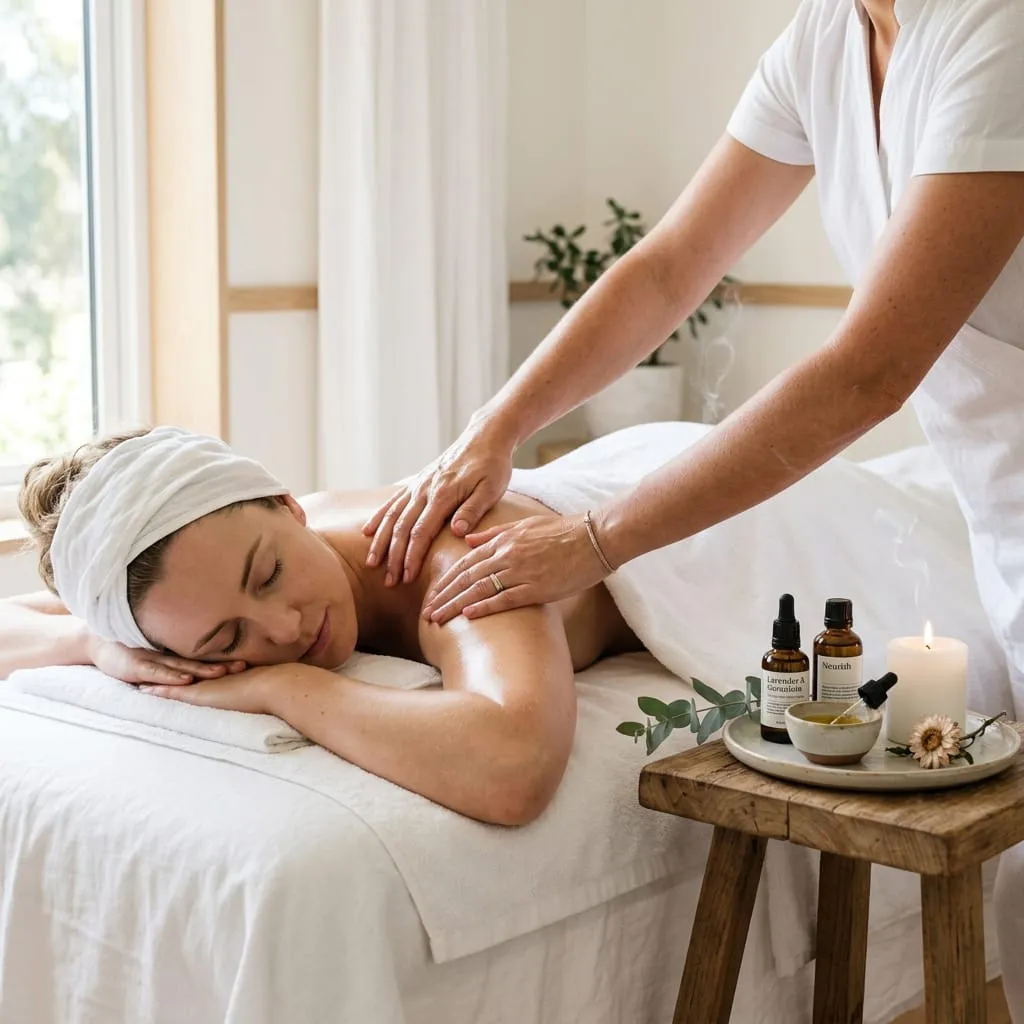
Mayo Clinic's list of 13 benefits covers the same ground and adds a few: slower breathing, eased muscle tension and chronic pain, and better focus, mood and sleep quality. Mayo also lists massage itself as a relaxation technique, next to the do-it-yourself methods below.
Mayo Clinic lists massage as a relaxation technique, next to the ones you can do at home.
How do you do deep belly breathing?
Sit or lie somewhere quiet, put a hand on your belly, and breathe so that hand rises and falls instead of your shoulders. Slow the exhale. Even a couple of minutes may help, and you need no app, cushion or course. Mayo Clinic lists deep breathing among its relaxation techniques, and of all of them it asks the least of you.
The supporting research is real but uneven. NCCIH's reference list on stress includes the 5 breathing studies in the table below. For home practice the most useful is Toussaint's, which put deep breathing side by side with progressive muscle relaxation and guided imagery.
A fair caveat: much of this research uses small samples and short follow-up, and the Twal study on inflammation markers is labeled a pilot. The effect on how you feel in the moment is reasonably well supported, and claims about long-term disease outcomes rest on weaker ground.
Breathe so the hand on your belly rises and falls instead of your shoulders.
| Study | Year | What it tested | What it reported |
|---|---|---|---|
| Joseph and colleagues, Hypertension | 2005 | Slow breathing in people with essential hypertension | Better arterial baroreflex sensitivity and lower blood pressure |
| Martarelli and colleagues | 2011 | Diaphragmatic breathing after a meal | Less postprandial oxidative stress |
| Twal and colleagues (pilot trial) | 2016 | Yogic breathing against an attention control | Lower levels of pro-inflammatory markers in saliva |
| Hopper and colleagues (systematic review) | 2019 | Diaphragmatic breathing in adults | Reduced physiological and psychological stress |
| Toussaint and colleagues | 2021 | Deep breathing, progressive muscle relaxation and guided imagery | All 3 promoted psychological and physiological states of relaxation |
How does progressive muscle relaxation work?
You tense one muscle group for about 5 seconds, release it for 30 seconds, and work your way up from your toes to your head. Mayo Clinic describes it as slowly tensing and then relaxing each muscle group, which helps you notice the difference between tension and release. If "just relax" has never worked for you, this gives you a script to follow.
It is one of the better-studied at-home methods. The Toussaint study measured relaxation from it, and a 2016 study on NCCIH's list, by Aalami and colleagues, looked at progressive muscular relaxation and breathing control on blood pressure during pregnancy. As with the breathing research, the samples are modest. Mayo's steps:
- Find a quiet area where you won't be interrupted, and sit or lie down comfortably.
- Start at your toes: tense the muscles for about 5 seconds.
- Release, and stay relaxed for a full 30 seconds. People tend to rush this part.
- Move to the next muscle group and repeat, working up to your neck and head. You can also go the other way, from head to toes.
What are visualization and autogenic relaxation?
Both use your imagination instead of your muscles, and Mayo Clinic names both. Visualization means building a detailed mental picture of a calm place and stepping into it. Autogenic means self-generated: you repeat calming words in your mind, picture a peaceful setting, and focus on slowing your breathing or heart rate, or on relaxing each of your 4 limbs one at a time.
For visualization, Mayo's advice is to use as many senses as you can. Its own ocean example uses 3: the smell of salt water, the sound of crashing waves, the warm sun on your skin. Close your eyes, sit somewhere quiet, loosen any tight clothing, focus on your breathing, and try to stay in the present with positive thoughts. The sensory detail keeps your attention on the scene instead of letting your mind slide back to your to-do list.
Autogenic relaxation resembles the guided imagery in the Toussaint study, though Mayo and NCCIH describe the two methods in their own terms. Imagery is harder to test cleanly than breathing and asks more of you up front: expect your mind to wander the first few times. Start with breathing or muscle relaxation for a quicker result, and come back to imagery once sitting still feels familiar.
| Technique | How it works | What the research shows |
|---|---|---|
| Deep breathing | Belly breathing with a slow exhale; a hand on the stomach confirms the rise and fall | Reduced stress in adults (Hopper review); lowered blood pressure in hypertension (Joseph) |
| Progressive muscle relaxation | Tense and release each muscle group in turn, from toes to head | Produced measured relaxation (Toussaint 2021); studied for blood pressure in pregnancy (Aalami) |
| Visualization | A detailed mental scene of a calm place, using as many senses as possible | Harder to test cleanly; guided imagery matched breathing and muscle relaxation in Toussaint 2021 |
| Autogenic relaxation | Repeated calming words plus body awareness: slowing the breath, relaxing limbs one at a time | Described by Mayo Clinic; resembles the guided imagery tested in the research |
How often should you practice relaxation techniques?
A few minutes most days, kept up over weeks. Mayo Clinic puts it plainly: relaxation techniques are skills, and like any skill, your ability to relax improves with practice. Be patient with yourself and don't let the effort to relax become one more stressor. If one technique doesn't suit you, try another. If none of them touches your stress, Mayo says to talk to a healthcare professional about other options.
Practice brings a second benefit Mayo points out. You get better at noticing the early physical signs of stress, such as muscle tension and shallow breathing, so you can use a technique right then, before stress builds and starts cutting into your quality of life.
Mayo also treats relaxation as one coping method among several. Its list of 9 others includes regular exercise, enough sleep, a healthy diet, time outside, and staying connected to supportive family and friends. How massage relates to sleep is a separate question, covered in our massage and sleep guide.
Mayo Clinic notes that these techniques are often free or low cost, pose little risk, and can be done anywhere. The easiest way to keep going is to attach the practice to something you already do:
- 3 or 4 minutes of belly breathing before you open your laptop.
- A few rounds of progressive muscle relaxation in bed, which fits the better sleep quality Mayo lists among the benefits.
- A short visualization while the coffee brews.
Are relaxation techniques safe for everyone?
For most healthy people, yes. NCCIH states that relaxation techniques are generally considered safe for healthy people, and that most research studies have reported no negative side effects. Its fact sheet on mind and body practices, a category whose 7 named examples include meditation, massage, yoga, tai chi and relaxation techniques, says they generally have good safety records when done properly.
There are exceptions, and they are specific. NCCIH notes that some people occasionally report negative experiences such as increased anxiety, intrusive thoughts or fear of losing control. There have also been rare reports that certain relaxation techniques might cause or worsen symptoms in people with epilepsy or certain psychiatric conditions, or in those with a history of abuse or trauma.
NCCIH adds 2 more cautions. Safe for most people doesn't automatically mean safe for you: a medical condition or a circumstance such as pregnancy can change the picture. And none of this is a reason to put off seeing a clinician about a health problem. If you have high blood pressure, keep following the treatment plan your provider prescribed and discuss any complementary approach with them first.
To begin, pick one technique (belly breathing is the easiest) and do it for 3 minutes today, attached to something you already do. When you want a regular appointment to anchor the habit, Wellness Massage Spa in southwest Gainesville is open every day from 9:30 AM to 10 PM.
Questions people ask
Can relaxation techniques replace a massage?
They reach the same relaxation response by a different route. Mayo Clinic lists massage as one relaxation technique among several, next to deep breathing, progressive muscle relaxation and visualization. The at-home methods cost little and need no appointment; a massage adds hands-on work on tight muscles. You can use both: a massage when you book one, and a few minutes of practice on the days between.
What is the easiest relaxation technique for beginners?
Belly breathing. Sit or lie somewhere quiet, put a hand on your belly, and breathe so the hand rises and falls while your shoulders stay still, with a slow exhale. A couple of minutes is a reasonable place to start. A systematic review on NCCIH's reference list found diaphragmatic breathing reduced physiological and psychological stress in adults.
How long should a relaxation session last?
The sources set no fixed length. Mayo Clinic's progressive muscle relaxation uses about 5 seconds of tension and 30 seconds of release per muscle group, so a pass from toes to head takes several minutes, and a couple of minutes of belly breathing is a reasonable place to start. Regular practice matters more than session length: Mayo says your ability to relax improves with practice.
Can relaxation techniques help me sleep?
They may. Mayo Clinic lists better sleep quality among the benefits of relaxation techniques, and progressive muscle relaxation is easy to do in bed. NCCIH also notes chronic stress may contribute to or worsen sleep disorders. If poor sleep continues, talk to your doctor rather than relying on relaxation practice alone.
What if a relaxation technique makes me anxious?
Stop. NCCIH notes that some people occasionally report increased anxiety, intrusive thoughts or fear of losing control during relaxation techniques, and Mayo Clinic says anyone who feels emotional discomfort should stop and talk to a healthcare or mental health professional. Try a different technique another day, or ask your doctor which approach suits you.
Sources
- Mayo Clinic — Relaxation techniques: Try these steps to lower stress
- NCCIH — Mind and Body Practices
- NCCIH — Stress
Written by Wellness Massage Spa from the primary sources above. Sessions at our Gainesville studio are performed by licensed massage therapists; Florida licenses every therapist through the Florida Board of Massage Therapy.
This guide is for general education only and is not medical advice. Talk with your healthcare provider about what is right for you.
Anchor the habit
Pair the practice with a regular Relaxation Massage
Our Relaxation Massage is a gentle, full-body treatment made to ease daily stress. It costs $80 for 60 minutes or $120 for 90 minutes. Lavender, rose or ginger essential oil is a $10 add-on to a massage; call (352) 339-6646 or ask at the studio. Do the breathing on the days between visits.
Wellness Massage Spa · 5750 SW 75th Ct Ste 20, Gainesville, FL 32608 · (352) 339-6646 · Open daily 9:30 AM – 10 PM.
Keep reading
Massage and sleep
What the research says about massage and sleep quality, hedges included.
Read
Massage for stress and anxiety
Cortisol, endorphins, and where the studies are thinner than the headlines.
Read
Relaxation Massage
Gentle and full-body. Book 60, 90 or 120 minutes online, or call for other lengths.
Read